That half-used jar in the back of your medicine cabinet can feel strangely mysterious. It looks the same, smells like almost nothing, and seems practically indestructible—but does vaseline expire, or is it one of those products that lasts forever?
The answer matters because petroleum jelly is often used on dry lips, cracked heels, irritated skin, minor scrapes, diaper areas, and sensitive spots where cleanliness and product quality actually matter. Vaseline’s own guidance says its jelly has an expiry date, should be checked before use, and is anhydrous, meaning it does not contain water and is less likely to develop bacterial growth over time.
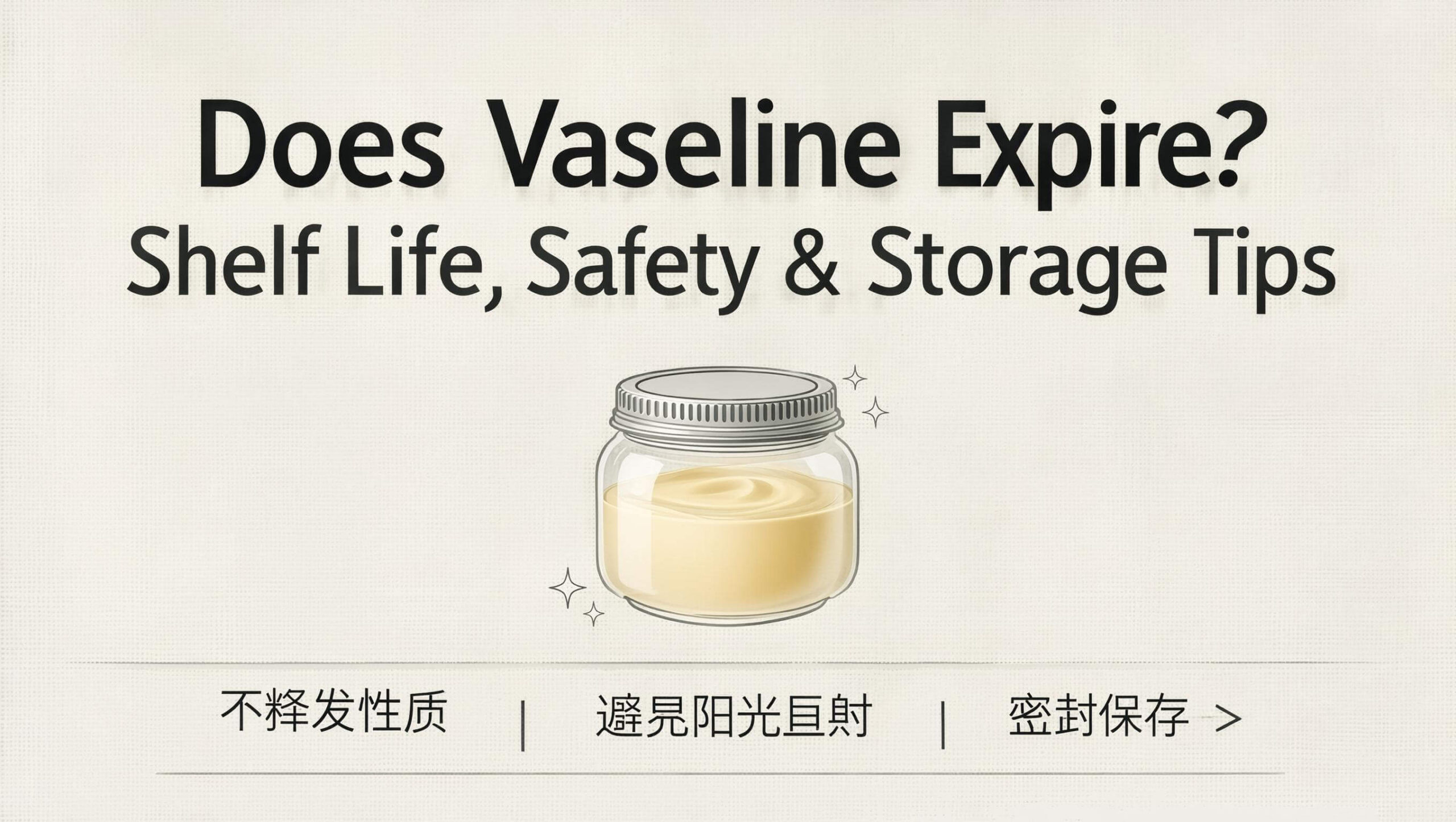
[Image: A clean jar of petroleum jelly on a bathroom shelf beside simple skincare items.]
The tricky part is that expired petroleum jelly does not usually announce itself the way spoiled food does. There may be no sour smell, no mold, and no dramatic color change. That is why knowing what to check—and when to toss it—can save you from using an old, contaminated, or less pleasant product on your skin.
This guide walks through the real shelf life of Vaseline® Jelly, what expiration dates mean, how to tell when a jar has gone bad, and how to store it so it stays usable for as long as possible.
does vaseline expire?
Yes, Vaseline can expire. The most practical answer to does vaseline expire is simple: check the date printed on the package and follow it, especially when you are applying it to irritated, cracked, or healing skin. Vaseline states that its jelly can have a long shelf life, but the label’s expiry date is still the safest guide.
That does not mean it suddenly becomes dangerous the morning after the printed date. Petroleum jelly is unusually stable compared with water-based lotions and creams because it is made from purified petrolatum and does not rely on water as part of the formula. Vaseline describes its Original Healing Jelly as 100% pure, triple-purified white petrolatum USP, and its product page notes that it works by creating a protective barrier that locks in moisture.
What “expiration” really means
Expiration is the point up to which the manufacturer is willing to stand behind the product’s quality, stability, and intended performance when stored properly. For a product like petroleum jelly, that usually has more to do with guaranteed quality than with sudden spoilage.
A better question than does vaseline expire is: “Is this jar still clean, stable, and suitable for where I want to use it?” A sealed jar kept in a cool cabinet is very different from a jar that has spent years in a hot car, been opened hundreds of times, or had fingers dipped into it after touching irritated skin.
Why petroleum jelly lasts so long
Petroleum jelly lasts longer than many skincare products because it is simple, oil-based, and water-free. Bacteria and mold generally need water to thrive, which is why creams, lotions, and gels with water-rich formulas often have a more obvious shelf-life concern than plain petroleum jelly.
Vaseline specifically says its jelly is anhydrous and therefore not likely to develop bacterial growth over time. That does not make every opened jar automatically sterile forever, but it explains why people often find old petroleum jelly looking surprisingly unchanged after years in a drawer.
[Image: Infographic showing three checks: date, smell, texture.]
It acts as an occlusive
Petroleum jelly is an occlusive, which means it forms a barrier on the skin to help reduce moisture loss. Mayo Clinic describes petroleum jelly as sitting on top of the skin like a protective layer that helps keep moisture from escaping.
That barrier effect is also why people use it for chapped lips, dry cuticles, rough elbows, cracked heels, and wind-exposed skin. Vaseline’s ingredient information describes petrolatum jelly as an occlusive moisturizer that helps protect and moisturize while supporting barrier recovery.
Why does vaseline expire if it contains no water?
The reason does vaseline expire is not because it spoils like milk. It is because packaging, storage conditions, contamination, heat exposure, and time can all affect product quality.
Over time, an opened jar can collect lint, skin cells, dust, cosmetic residue, or bacteria from repeated finger contact. Heat can soften the jelly and make separation or texture changes more noticeable. If the lid is left loose, the surface can pick up odors from nearby products. None of that means every old jar is unsafe, but it does mean “looks okay” is not the only standard.
How to read the expiration date on Vaseline
Start with the outer box if you still have it, then check the bottom, back, rim, crimp, or label of the jar, tube, or tin. Some packages use an expiry date, while others may show a batch code or period-after-opening symbol depending on the country and product type.
If you cannot find any date, treat the product with more caution. Ask yourself when you bought it, how it has been stored, whether it has been opened, and where you plan to use it. A forgotten jar from last winter is one thing; a sticky, dusty jar from a decade ago is another.
For plain petroleum jelly that looks, smells, and feels normal, some people keep using it beyond the printed date for low-risk uses such as softening rough heels. But when the product is going near broken skin, a baby’s skin, a medical dressing, or a highly irritated area, replacing it is the cleaner and more sensible choice.
Signs your Vaseline should be thrown away
The phrase does vaseline expire often comes up because the product can look unchanged for a very long time. Still, there are clear warning signs that a jar has passed its best days.
Throw it away if you notice:
- A strange, rancid, smoky, chemical, or perfumed odor
- Yellowing, darkening, grayness, or visible dirt
- Grit, clumps, crust, or a grainy texture
- Water droplets, separation, or unusual stickiness
- Mold, specks, lint, or debris in the jar
- A cracked, broken, swollen, rusty, or leaking container
- Uncertainty about what touched the product
Texture matters because petroleum jelly should feel smooth, uniform, and semi-solid. If it has become gritty, crumbly, unusually runny at room temperature, or mixed with unknown residue, it is no longer worth keeping.
Smell matters too. Plain Vaseline® Jelly is usually odorless or nearly odorless. If your jar smells strongly like perfume, medicine, smoke, old oil, cleaning products, or mildew, it may have absorbed odors or been stored poorly.
Is expired Vaseline dangerous?
Expired Vaseline is not automatically dangerous, but it may not be the best choice for sensitive, irritated, or compromised skin. The safer approach is to judge it by the printed date, appearance, smell, storage history, and intended use.
The FDA’s OTC skin protectant monograph defines skin protectant products as products that temporarily protect injured or exposed skin or mucous membrane surfaces from harmful or annoying stimuli and may provide relief. DailyMed labeling for white petrolatum jelly also lists uses such as temporarily protecting minor cuts, scrapes, and burns, helping relieve chapped or cracked skin and lips, and protecting against drying from wind and cold weather.
That matters because the more vulnerable the skin, the cleaner your product should be. If a jar is expired and has been repeatedly opened, shared, or handled with unwashed fingers, it is not ideal for cracked lips, raw nostrils, fresh scrapes, or irritated diaper-area skin. You may read this: Signs To Stop Water Fasting: Know When to End It Safely.
When not to use old Vaseline
Do not use old or questionable petroleum jelly on deep wounds, puncture wounds, animal bites, or serious burns. DailyMed labeling for white petrolatum jelly includes warnings for external use only and says not to use it on deep or puncture wounds, animal bites, or serious burns.
You should also be cautious around the eyes, after cosmetic procedures, on infected skin, or anywhere a doctor has given specific wound-care instructions. Petroleum jelly can be helpful in many basic skin-care situations, but it is not a substitute for medical care.
Mayo Clinic also notes that petroleum jelly should never be used in the nose of infants and small children. For older children, Mayo describes only a thin layer as something that may soothe a tender winter nose, and recommends talking with a doctor for more information.
[Image: Person closing a jar tightly and storing it in a cool cabinet.]
How storage affects shelf life
Storage can make the difference between a jar that stays clean and pleasant for years and one that becomes messy long before the printed date. Keep petroleum jelly in a cool, dry place away from direct sunlight, heaters, steamy bathrooms, and car glove compartments.
The bathroom is convenient, but it is not always the best storage spot. Showers create warmth and humidity, and bathroom counters often expose jars to splashes, dust, hair products, and repeated handling. A bedroom drawer, linen closet, or medicine cabinet away from heat is usually better.
Always close the lid tightly after each use. A loose lid lets dust and odors settle onto the surface. It also makes it easier for the jar to collect debris from towels, cotton swabs, makeup brushes, or other products nearby.
How to keep your jar cleaner
The cleanest method is to scoop out petroleum jelly with freshly washed hands, a clean cotton swab, or a small spatula. Avoid dipping back into the jar after touching your skin, especially if the skin is cracked, bleeding, infected, or irritated.
For families, consider using separate jars for different purposes. One jar for feet, one for baby care, and one for lips is more hygienic than everyone sharing the same container. Tubes can also be cleaner for travel because less of the product is exposed to air and fingers.
If you use Vaseline on lips during a cold, around a raw nose, or near irritated skin, avoid reusing the same finger and then dipping back into the jar. That habit is one of the easiest ways to contaminate an otherwise stable product.
Does the container type matter?
Yes, container type can affect cleanliness. Jars expose a larger surface area and invite finger-dipping, so they require better handling. Tubes reduce direct contact with the product inside, which can make them more convenient for lips, travel bags, and shared spaces.
Small tins are portable, but they often end up in pockets, purses, cars, gym bags, and hot environments. If a tin has melted repeatedly, collected lint, or picked up a strange smell, replace it.
The original formula is also different from flavored lip products, lotions, or petroleum-jelly blends with added fragrance, cocoa butter, aloe, or other ingredients. Mixed formulas may have different stability expectations than plain 100% white petrolatum, so check the individual label rather than assuming every Vaseline-branded product behaves the same way.
Can you use expired Vaseline on your lips?
You can use petroleum jelly on lips when it is clean, normal-looking, and within its usable period. DailyMed labeling for white petrolatum includes helping relieve chapped or cracked skin and lips as a listed use.
However, lips are easy to irritate, and lip products often collect saliva, food residue, lipstick, and germs from fingers. If your jar is old, shared, gritty, dirty, or smells off, do not put it on your mouth.
This is one of the simplest places to follow the “when in doubt, throw it out” rule. A fresh tube or small jar is inexpensive compared with the discomfort of applying a questionable product to cracked lips.
Can you use expired Vaseline on wounds?
For minor scrapes, petroleum jelly can act as a protective skin barrier, but old or contaminated product should not be used on broken skin. DailyMed labeling lists temporary protection for minor cuts, scrapes, and burns, but it also includes warnings against use on deep or puncture wounds, animal bites, and serious burns.
So, does vaseline expire in a way that matters for wounds? Yes, because wound care is a higher-risk use. Even if the jelly itself is stable, an old jar may not be clean enough for freshly damaged skin.
For fresh cuts, post-procedure care, burns, or anything that looks infected, follow medical advice and use a clean, current product. Redness, swelling, pus, increasing pain, warmth, fever, or red streaks are signs to seek medical care rather than relying on a bathroom jar.
What happens if you accidentally used expired Vaseline?
Most people who use a small amount of old petroleum jelly once will not have a problem, especially if the product looked and smelled normal. Wash the area gently if you are worried, then watch for irritation.
Stop using it if your skin becomes itchy, red, bumpy, painful, or more inflamed than before. If the product was applied to broken skin, a baby’s skin, near the eyes, or on a wound that is worsening, it is worth checking with a healthcare professional.
The bigger issue is repeated use. If you keep using an expired or contaminated jar day after day, you increase the chance of irritation or introducing unwanted debris to sensitive skin.
Myths about Vaseline and expiration
One common myth is that petroleum jelly never expires. It lasts a long time, but Vaseline itself says to check the expiry date, so “forever” is not the right standard.
Another myth is that an old jar is fine as long as there is no mold. Mold is not the only sign of a problem. Changes in odor, texture, color, cleanliness, and packaging can all be good reasons to toss it.
A third myth is that heating or melting old petroleum jelly makes it new again. Heat may soften the texture, but it does not erase age, contamination, debris, or storage history. If a jar looks questionable, replacing it is the better fix.
Practical replacement rule
Here is a simple rule: follow the printed date first. If there is no date, replace opened jars that are very old, poorly stored, shared often, or used for sensitive areas.
Keep a fresher product for lips, babies, irritated skin, and minor scrapes. Use older-but-normal product only for low-risk cosmetic uses, such as softening rough heels or protecting dry elbows—never on serious wounds or questionable skin concerns.
That is the most balanced answer to does vaseline expire: yes, but the real decision depends on date, condition, cleanliness, and use.
FAQ
How long does Vaseline usually last?
Vaseline can have a long shelf life, but the safest answer is to check the expiry date on the label. The brand’s own guidance says Vaseline® Jelly has an expiry date and users should check the product label before applying it.
Can bacteria grow in Vaseline?
Plain Vaseline® Jelly is anhydrous, meaning it does not contain water, and Vaseline says this makes it not likely to develop bacterial growth over time. However, an opened jar can still become contaminated through dirty fingers, debris, shared use, or poor storage.
Does Vaseline smell bad when it expires?
It may not smell bad, which is why the date and visual checks matter. Still, a rancid, chemical, smoky, musty, or perfumed odor is a good reason to throw it away.
Is it okay to use Vaseline after the expiration date?
For low-risk uses, some people use petroleum jelly past the printed date if it looks, smells, and feels completely normal. For lips, babies, broken skin, irritated skin, or minor wound care, it is smarter to replace it.
does vaseline expire faster after opening?
Yes, it can become less clean after opening because the product is exposed to fingers, air, dust, and storage conditions. The formula may remain stable, but the jar’s cleanliness depends on how it is handled.
Can expired Vaseline cause a rash?
It can irritate some people if the product has changed, picked up contaminants, or been applied to sensitive skin. Stop using it if redness, itching, burning, bumps, or worsening irritation appears.
Is Vaseline safe for minor cuts?
White petrolatum jelly is labeled for temporarily protecting minor cuts, scrapes, and burns, but it should not be used on deep or puncture wounds, animal bites, or serious burns.
Should I keep Vaseline in the bathroom?
You can, but a cool, dry cabinet away from steam, heat, and splashes is better. Always keep the lid tightly closed and avoid dipping dirty fingers into the jar.
Does petroleum jelly with fragrance expire differently?
It can. Products with added fragrance, flavor, botanical ingredients, cocoa butter, aloe, or other extras may have different stability than plain 100% white petrolatum. Always follow the specific product label.
Conclusion
So, does vaseline expire? Yes—but not in the dramatic, obvious way food expires. Plain petroleum jelly is stable, water-free, and long-lasting, yet it still has a printed expiry date and can become less suitable over time depending on how it is stored and handled.
Use the date as your first guide. Then check the smell, color, texture, cleanliness, and container condition. For rough heels or dry elbows, an older jar that looks perfect may be low risk. For lips, babies, broken skin, irritated areas, or wound care, fresh and clean is the better choice.
When a jar looks questionable, smells strange, feels gritty, or has been sitting around for years, replacing it is the easy decision. Petroleum jelly is inexpensive, versatile, and useful—but only when the product in the jar is still clean enough for the skin you are putting it on.