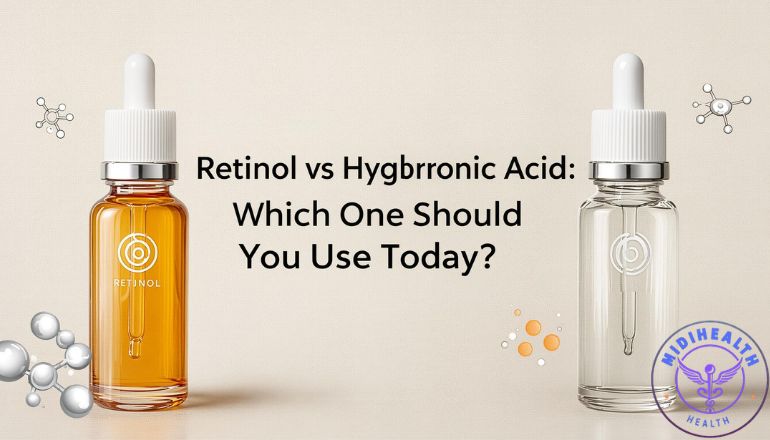
Some skincare ingredients sound like they belong in a science lab, yet somehow end up sitting right beside your toothbrush. Retinol and hyaluronic acid are two of the biggest examples. The debate around retinol vs hyaluronic acid can feel confusing because both are praised everywhere, but they do very different jobs.
One is known for encouraging smoother-looking skin over time. The other is loved for giving skin that fresh, hydrated, bouncy feel almost immediately. So, which one does your skin actually need?
That question matters because choosing the wrong product, or using the right product the wrong way, can leave your skin dry, irritated, shiny, sticky, or just plain disappointed. But when you understand how these ingredients work, they stop feeling intimidating.
![Image placeholder: Close-up of hydrated, healthy-looking skin with retinol and hyaluronic acid product bottles on a bathroom counter.]
The good news? This is not really a battle where one ingredient must win. For many people, the smartest routine includes both, just in different ways and at different times.
What Is Retinol?
Retinol is a vitamin A derivative used in skincare to support skin renewal. It belongs to a wider family called retinoids, which includes over-the-counter options like retinol and stronger prescription forms.
In simple terms, retinol helps encourage the skin’s natural turnover process. That means it supports the way older surface cells shed and newer-looking skin comes forward. This is why retinol is often used for dullness, uneven texture, clogged pores, fine lines, and visible signs of aging.
Retinol is not usually a “wake up glowing tomorrow” ingredient. It works gradually. Many people notice early texture changes after several weeks, while more visible improvements in fine lines or discoloration can take months of consistent use.
What Retinol Does for Skin
Retinol is often chosen when someone wants to improve skin quality over time. It can help with:
- Fine lines and wrinkles
- Uneven skin texture
- Dullness
- Enlarged-looking pores
- Mild breakouts
- Post-blemish marks
- Rough patches
- Early signs of photoaging
Its biggest strength is long-term change. Retinol does not simply sit on top of the skin and make it feel softer for a few hours. It encourages processes that can make skin look smoother, clearer, and more refined with patience.
Who Should Be Careful With Retinol?
Retinol can be powerful, but that also means it is not ideal for everyone in every situation. People with very sensitive skin, eczema-prone skin, rosacea-prone skin, or a damaged moisture barrier may find it irritating.
Common early reactions can include dryness, flaking, tightness, redness, burning, or stinging. This does not always mean the ingredient is “bad” for you, but it may mean the strength is too high, the frequency is too aggressive, or your skin barrier needs repair first.
Pregnant or breastfeeding people should speak with a healthcare professional before using retinoids. When in doubt, it is always better to get personal guidance than guess.
What Is Hyaluronic Acid?
Hyaluronic acid is a moisture-binding ingredient naturally found in the body, including the skin. In skincare, it is usually used as a humectant, which means it helps attract and hold water.
Despite the word “acid,” hyaluronic acid is not an exfoliating acid like glycolic acid or salicylic acid. It does not peel the skin. It does not resurface. It does not speed up cell turnover. Its main role is hydration.
That makes it especially popular for skin that feels tight, dehydrated, tired, or flat. A good hyaluronic acid serum can make skin look plumper and feel more comfortable, especially when layered correctly.
![Image placeholder: Lightweight serum texture being applied to damp skin, showing a fresh hydration-focused routine.]
What Hyaluronic Acid Does for Skin
Hyaluronic acid is useful because hydration affects how skin looks and feels. Dehydrated skin can make fine lines appear more noticeable, makeup apply unevenly, and the face look less fresh.
Hyaluronic acid may help with:
- Temporary plumping
- Surface hydration
- Softness
- A smoother makeup base
- Tightness caused by dehydration
- Supporting a comfortable skin barrier
- Balancing routines that include stronger actives
It is generally easy to pair with other ingredients. This is one reason it appears in serums, moisturizers, eye creams, sunscreens, masks, and even cleansers. You may read this: Midi Health Weight Loss Reviews: Real Results Guide 2026.
Can Hyaluronic Acid Dry Out Skin?
This surprises people, but yes, it can sometimes make skin feel drier if used incorrectly. Hyaluronic acid attracts water, so it works best when applied to slightly damp skin and followed with a moisturizer.
If you apply it to dry skin and skip moisturizer, especially in a very dry climate, your skin may feel tight instead of juicy. The fix is simple: apply it after cleansing while skin is still a little damp, then seal it with a cream or lotion.
Retinol vs Hyaluronic Acid: The Core Difference
The easiest way to understand retinol vs hyaluronic acid is this: retinol is a treatment ingredient, while hyaluronic acid is a hydration ingredient.
Retinol focuses on long-term visible skin improvement. Hyaluronic acid focuses on water balance and comfort. One helps change the look of texture and aging signs over time; the other helps skin feel hydrated and look plumper right away.
They are not substitutes for each other. If your skin is breaking out, rough, sun-damaged, or showing fine lines, hyaluronic acid alone probably will not give you the same results as retinol. If your skin is dry, tight, or irritated, retinol alone may make things worse unless you support your barrier.
Quick Comparison
| Feature | Retinol | Hyaluronic Acid |
|---|---|---|
| Main role | Skin renewal and visible aging support | Hydration and plumping |
| Best for | Fine lines, texture, acne, dullness | Dryness, dehydration, tightness |
| Speed of results | Gradual, usually weeks to months | Often immediate feel |
| Irritation risk | Moderate to high, depending on skin | Low for most people |
| Best time to use | Usually evening | Morning or evening |
| Needs sunscreen? | Yes, daily sunscreen is important | Sunscreen still recommended |
| Beginner-friendly? | Yes, if introduced slowly | Usually yes |
Which Is Better for Fine Lines?
For fine lines, retinol is usually the stronger long-term choice. It supports collagen-related skin changes and helps improve the look of texture over time.
That said, hyaluronic acid can make fine lines look softer temporarily by hydrating the skin. Dehydration lines, especially around the eyes, forehead, and mouth, can look more obvious when the skin lacks water. A hydrating serum can make those lines appear less sharp.
So the best answer is not always one or the other. For long-term fine line care, retinol is the more targeted ingredient. For immediate plumping and comfort, hyaluronic acid is the helpful support ingredient.
Which Is Better for Dry Skin?
For dry or dehydrated skin, hyaluronic acid is usually the better starting point. It helps skin feel more supple and comfortable, especially when paired with a moisturizer that contains barrier-supporting ingredients.
Retinol can be tricky for dry skin because it may cause flaking or tightness during the adjustment period. That does not mean dry skin can never use retinol. It simply means the routine needs to be gentler.
A dry-skin-friendly approach might look like this:
- Use a creamy, non-stripping cleanser.
- Apply hyaluronic acid on damp skin.
- Follow with a rich moisturizer.
- Use retinol only two nights per week at first.
- Apply moisturizer before and after retinol if needed.
- Wear sunscreen every morning.
This “support first, treat second” mindset helps reduce the chance of irritation.
Which Is Better for Acne?
Retinol is usually more relevant for acne-prone skin because it can help with clogged pores and uneven skin turnover. Some retinoids are widely used in acne care for this reason.
Hyaluronic acid does not treat acne directly. However, it can still be helpful in an acne routine because many acne products are drying. Hydrated skin is often more resilient and less reactive, which can make it easier to stay consistent with active ingredients.
If you have acne-prone skin, look for lightweight, non-comedogenic hyaluronic acid formulas. Avoid heavy, sticky layers if your pores clog easily.
Can You Use Retinol and Hyaluronic Acid Together?
Yes, most people can use retinol and hyaluronic acid together. In fact, this pairing often makes sense because hyaluronic acid can help offset the dryness that sometimes comes with retinol.
This is where the retinol vs hyaluronic acid conversation becomes less about competition and more about teamwork. Retinol does the deeper long-term work, while hyaluronic acid helps keep the skin comfortable and hydrated.
Best Order to Apply Them
A simple evening routine could look like this:
- Cleanse your face gently.
- Apply hyaluronic acid to slightly damp skin.
- Wait a moment until it settles.
- Apply moisturizer if your skin is sensitive or dry.
- Apply a pea-sized amount of retinol.
- Finish with moisturizer if needed.
Some people prefer applying retinol before moisturizer. Others do better with the “sandwich method,” where moisturizer goes before and after retinol. Neither approach is automatically wrong. The best order depends on how tolerant your skin is.
![Image placeholder: Infographic showing AM routine with hyaluronic acid and SPF, and PM routine with hyaluronic acid, moisturizer, and retinol.]
Morning or Night: When Should You Use Each?
Hyaluronic acid can be used morning, night, or both. It plays well with most routines and can sit comfortably under moisturizer and sunscreen.
Retinol is usually best used at night. Many retinol products are sensitive to light, and the skin may also be more prone to irritation when starting. Night use keeps the routine simple and helps reduce unnecessary daytime stress on the skin.
In the morning, sunscreen is non-negotiable when using retinol. Not because retinol “thins” the skin in the scary way people sometimes claim, but because retinoid-treated skin can be more sensitive and because UV exposure works against the skin goals most people use retinol for in the first place.
How to Start Retinol Without Wrecking Your Skin
The biggest retinol mistake is doing too much too soon. People get excited, apply it every night, layer it with exfoliating acids, skip moisturizer, and then wonder why their face feels like sandpaper.
Start slow. A beginner routine might include retinol only two nights per week for the first few weeks. If your skin feels calm, you can increase gradually.
Beginner Retinol Tips
- Choose a low-strength formula.
- Use only a pea-sized amount for the whole face.
- Avoid the corners of the nose, mouth, and eyes at first.
- Do not apply to wet skin unless the product says to.
- Use moisturizer generously.
- Avoid using exfoliating acids on the same night in the beginning.
- Pause if your skin becomes painfully irritated.
Retinol rewards patience. More product does not mean faster results; it usually means more irritation.
How to Use Hyaluronic Acid for Best Results
Hyaluronic acid is easier to use, but technique still matters. The most common mistake is applying it like a standalone moisturizer. For most skin types, it works better as a hydration layer, not the final step.
Apply it to slightly damp skin after cleansing. Then use a moisturizer to seal everything in. In the morning, follow with sunscreen.
Best Pairings for Hyaluronic Acid
Hyaluronic acid works well with:
- Ceramides
- Glycerin
- Niacinamide
- Peptides
- Squalane
- Panthenol
- Aloe
- Lightweight moisturizers
- Barrier creams
It can also be used alongside retinol, vitamin C, and exfoliating acids, depending on your skin’s tolerance.
Retinol vs Hyaluronic Acid for Sensitive Skin
For sensitive skin, hyaluronic acid is usually the safer first step. It helps support hydration without pushing the skin to renew faster.
Retinol can still be used by some people with sensitive skin, but it needs a careful approach. Lower strengths, cream-based formulas, fewer application nights, and the moisturizer sandwich method can all help.
If your skin stings when you apply plain moisturizer, that is a sign your barrier may already be irritated. In that case, pause strong actives and focus on barrier repair before adding retinol.
Retinol vs Hyaluronic Acid for Oily Skin
Oily skin can still be dehydrated. This is why some people have a shiny face that also feels tight after cleansing. Hyaluronic acid can help add water without adding heavy oil.
Retinol can also be useful for oily or breakout-prone skin because it supports clearer-looking pores and smoother texture. The key is choosing the right formula. Lightweight gels, lotions, or serums may feel better than rich creams.
For oily skin, avoid building too many layers. A simple routine is often more successful than a crowded shelf full of half-used products.
Retinol vs Hyaluronic Acid for Mature Skin
Mature skin often benefits from both ingredients. Retinol can support smoother texture, more even tone, and the appearance of firmer skin over time. Hyaluronic acid helps address the dryness and loss of plumpness that often become more noticeable with age.
A mature-skin routine does not need to be harsh. In fact, comfort matters more as the skin becomes drier or more reactive. Retinol should be introduced gradually, and hydration should be consistent.
A strong routine might include hyaluronic acid daily, retinol a few nights per week, a nourishing moisturizer, and broad-spectrum sunscreen every morning.
Common Myths About These Ingredients
Skincare myths travel fast, especially when an ingredient becomes popular. Let’s clear up a few.
Myth 1: Hyaluronic Acid Replaces Moisturizer
It usually does not. Hyaluronic acid hydrates, but moisturizer helps seal and support the skin barrier. Most people need both.
Myth 2: Retinol Exfoliates Like a Scrub
Retinol is not a scrub and does not work by physically removing dead skin. It supports skin renewal at a biological level, which is why results take time.
Myth 3: You Cannot Use Retinol With Hyaluronic Acid
You can. They are commonly used together. Hyaluronic acid may actually make a retinol routine feel more comfortable.
Myth 4: Stronger Retinol Is Always Better
Not true. The best retinol is the one your skin can tolerate consistently. A gentle product used regularly often beats a strong product that leaves your skin irritated.
Myth 5: Hyaluronic Acid Is Only for Dry Skin
Oily, combination, acne-prone, and sensitive skin can also benefit from hydration. Dehydration is about water, not oil.
A Simple Routine Using Both Ingredients
Here is a practical routine for someone who wants hydration, smoother texture, and long-term skin improvement.
Morning Routine
- Gentle cleanser or rinse with water
- Hyaluronic acid on damp skin
- Moisturizer
- Broad-spectrum sunscreen
Evening Routine on Retinol Nights
- Gentle cleanser
- Hyaluronic acid on damp skin
- Moisturizer if skin is sensitive
- Pea-sized amount of retinol
- Moisturizer again if needed
Evening Routine on Non-Retinol Nights
- Gentle cleanser
- Hyaluronic acid
- Moisturizer
- Optional barrier-supporting oil or balm for dry areas
This kind of rhythm gives your skin active treatment without forgetting recovery.
How Long Until You See Results?
Hyaluronic acid can make skin feel more hydrated almost right away. The plumping effect may be visible quickly, although it is temporary and depends on consistent use.
Retinol takes longer. Some people notice smoother texture within a few weeks, but changes in fine lines, uneven tone, and firmness usually take several months.
That timeline can feel slow, but skin does not renew overnight. Consistency matters more than constantly switching products.
Side Effects and Safety Notes
Hyaluronic acid is generally well tolerated, but any ingredient can cause irritation for some people. If a product stings, burns, or causes bumps, stop using it and check the rest of the formula. Fragrance, alcohol, preservatives, or other actives may be the real issue.
Retinol has a higher chance of side effects, especially in the beginning. Dryness, peeling, redness, and sensitivity are common when overused. Start slowly and avoid combining it with too many strong products at once.
Do not use retinol on broken, freshly waxed, sunburned, or aggressively exfoliated skin. If you use prescription acne treatments or have a skin condition, ask a dermatologist how to combine products safely.
FAQ
Is retinol better than hyaluronic acid?
Retinol is better for long-term concerns like fine lines, uneven texture, clogged pores, and visible aging. Hyaluronic acid is better for hydration, plumping, and comfort. They solve different problems.
Can I use hyaluronic acid every day?
Yes, most people can use hyaluronic acid daily. It can be used in the morning, evening, or both, especially when followed with moisturizer.
Can I use retinol every night?
Some experienced users can, but beginners should not start that way. Begin with two nights per week and increase only if your skin stays calm.
Should I apply retinol or hyaluronic acid first?
Many people apply hyaluronic acid first on damp skin, then moisturizer, then retinol. If your skin is not sensitive, you may apply retinol before moisturizer. The best order depends on tolerance.
Is hyaluronic acid good after retinol?
Yes. Hyaluronic acid can be helpful in a retinol routine because it supports hydration. You can use it before retinol, after retinol, or in the same routine with moisturizer.
Which ingredient is better for glowing skin?
For a quick hydrated glow, hyaluronic acid is usually better. For long-term improvement in dullness and texture, retinol is more targeted.
Can retinol make skin dry?
Yes, retinol can cause dryness, peeling, or tightness, especially when first introduced. Using a lower strength and applying moisturizer can help.
Do I need sunscreen with retinol?
Yes. Daily sunscreen is important when using retinol because your skin may be more sensitive, and sun exposure can worsen the concerns retinol is meant to improve.
Can teenagers use retinol and hyaluronic acid?
Hyaluronic acid is generally suitable for many ages. Retinol use depends on the reason, such as acne or texture, and younger users should keep routines simple or speak with a dermatologist.
Conclusion
The retinol vs hyaluronic acid question is easier once you stop treating them like rivals. Retinol is the slow, steady ingredient for visible skin renewal. Hyaluronic acid is the hydration helper that makes skin feel smoother, softer, and more comfortable.
If your main concern is fine lines, acne, roughness, or uneven texture, retinol is likely the more targeted choice. If your skin feels tight, thirsty, or dull from dehydration, hyaluronic acid is the friendlier place to start.
For many routines, the best answer is both. Use hyaluronic acid to keep your skin hydrated and supported, and use retinol carefully for long-term refinement. Give your skin time, protect it with sunscreen, and remember that healthy skin usually comes from consistency, not chaos.